
The complete guide
Choosing replacement flyscreen mesh
Which grade and sheet size do you need?
Three grades, in three sheet sizes from 100 x 100 cm up to 200 x 200 cm. Every combination and its price is in the picker above.
Measure the panel you are re-skinning and go up to the next sheet size, allowing a margin at each edge for whatever holds the mesh in place. You can always cut a sheet down. You cannot add to one.
The mesh is the part that fails
Everything else on a fly screen tends to outlive it. The PVC frame, the corner pieces, the magnetic strip, the hook-and-loop tape: none of those is usually the reason a screen stops working. The mesh is.
Sometimes it is a cat. Sometimes it is a branch, a bike handlebar or a wheelbarrow. Often it is simply age and sun. Whichever it was, replacing a flat sheet costs a fraction of replacing the screen, and the job is a blade and twenty minutes.
This is mesh only. No frame, no tape, no corner pieces. If you are building a screen from nothing rather than repairing one, all of those are sold separately here, by the metre and by the set.
Which grade to re-skin in
Work backwards from what went wrong.
If a cat or a dog put the hole there, the answer is pet mesh, vinyl-coated polyester woven 10 x 16. Re-skinning in standard fibreglass puts you exactly where you started, usually inside a fortnight.
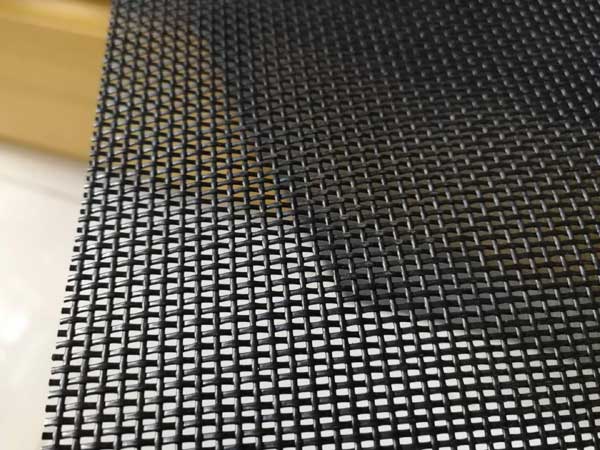
If nothing tore but small insects were getting through anyway, the answer is midge mesh: black fibreglass at 20 x 20 to the square inch, 0.33mm strand, 45% open area. This is the grade sold elsewhere as no-see-ums screen, and it stops midges, gnats and sand flies.
If the old mesh simply wore out, standard grey is the sensible re-skin. Fibreglass at 18 x 16, 0.279mm strand, 66% open area, and the airiest and least visible of the three.
All three are woven from coated yarn, all three resist rust, corrosion and staining, and the two fibreglass grades are non-combustible.
Cutting it
Measure the panel and buy the next sheet size up, because there is nothing to be done with a sheet that came up short.
Cut with a blade or a strong, sharp pair of scissors. Blunt scissors drag the weave instead of cutting it and leave an edge that frays. Allow a margin at every edge for whatever holds the mesh in your frame, whether that is a spline in a groove, a stitched edge or a strip of tape.
One large sheet will make several small screens, and if you are re-skinning a whole house that is almost always the cheaper way round.
It does not have to be one of ours
Nothing about a flat sheet of mesh cares who made the screen it is going onto. Aluminium framed screens with a spline and groove are the most common case and the most straightforward, because fibreglass mesh is what they were designed around in the first place.
The one to think twice about is a velcro-edged panel, where the edge itself has to be re-attached. That is a rebuild rather than a re-skin, and buying the panel complete is often less work.