
The complete guide
Choosing a cat-proof window screen
Which size do you need?
Five sizes, from 100 x 100 cm up to 200 x 200 cm, all on the same pet mesh. The picker above carries each one with its price.
There is one rule: order above your opening. The panel cuts down with a blade or a strong pair of scissors, so a size larger than the window becomes a screen made to measure. A size smaller is a screen you cannot use.
Measure the frame recess, not the glass. The tape goes on the flat face of the frame around the opening, and that face is what the panel has to reach.
Why a cat needs a different screen
A cat screen is simply a screen a cat cannot get through, and the difference is entirely in the yarn.
An ordinary insect screen is thin fibreglass. A cat that wants to be on the other side of it is through in a few days, by claws or by chewing. Pet mesh is heavy vinyl-coated polyester woven 10 x 16 to the square inch, and it holds up to both.
What you get for that is two things at once. The cat stays in and the insects stay out, on the same panel, which is not true of any other grade we sell.
The part nobody likes talking about
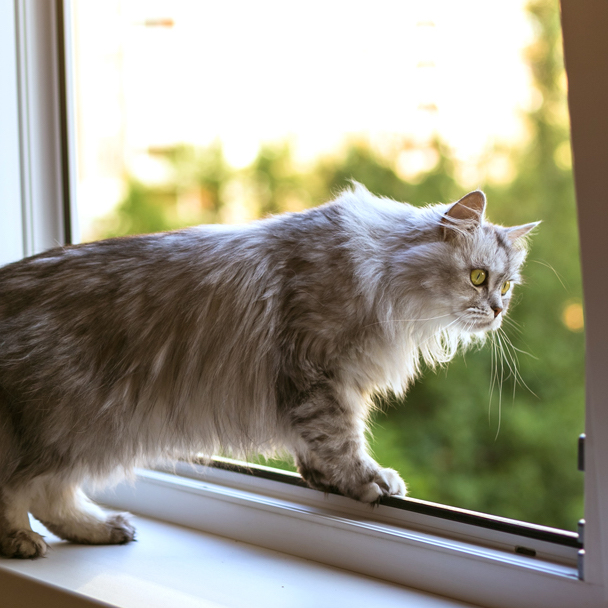
Cats fall out of windows. They are curious, they like height, they nap in ridiculous places, and an open window on a warm day is an open invitation onto a ledge. Landing on their feet does not stop them being badly hurt.
That is the reason most of these get bought, and it is worth being straight about what a screen is and is not. This is a screen that will hold against a cat pushing and clawing at it. It is not a guard rail, it is not rated as a fall barrier, and it should never be relied on the way you would rely on a window restrictor. Fit it properly, and look at it now and then.
Fitting it, and the 24 hours that matter
The panel has a velcro edge and it presses onto a self-adhesive hook-and-loop strip you run around the window frame. That is the whole system. No frame to assemble, no brackets, no drill, and nothing that marks the frame when it comes off.
Almost everything that goes wrong with one of these is the tape, and almost every one of those is the fitting. Clean the frame face of dust and grease, finish with an alcohol wipe, and let it dry. Work at 18 degrees or warmer in dry air, warming the frame with a hair dryer first if the room is cold. Peel the liner back about 25mm at a time and keep your fingers off the glue.
Then press it down hard with the back of a teaspoon, corners included, because the adhesive is pressure sensitive and the corners are what lifts first.
Then leave it 24 hours before you put the screen on. A strip that lets go cannot be reused.
Cutting it to the window
Order a size above your opening and cut the panel down with a blade or a strong pair of scissors. Under-order and there is nothing to be done, because mesh does not stretch.
Measure the frame recess rather than the glass, and in an older house measure every window on its own. Out of square is fine. You are cutting the panel to the window, so a shaped or crooked opening is no more work than a neat rectangle.
Living with it
Wash it in warm soapy water when it needs it, dry it fully, and put it back. At the end of the season peel the panel off and store it flat, leaving the tape on the frame so next spring is a one-minute job.
If the mesh ever gets damaged, pet mesh is sold on its own as replacement flyscreen mesh, so the panel gets re-skinned instead of replaced.